
The 2000s didn’t feel like the beginning of a new era. If anything, they felt like something quietly falling apart.
The millennium came and went, the internet exploded, CDs disappeared, and suddenly music was everywhere and worth almost nothing.
For a lot of artists, the future stopped looking like a career path and started looking like something you just had to survive.
Looking back, the decade feels suspended in a strange emotional space. Not hopeful, not completely hopeless either. Just uncertain.
The ’90s were the last era where people still believed music might save them. By the 2000s, music had slowly turned into something else. An escape route.
People weren’t trying to change the world anymore.
They were trying to hide from it.
And that shift shaped the sound of the decade’s underground.
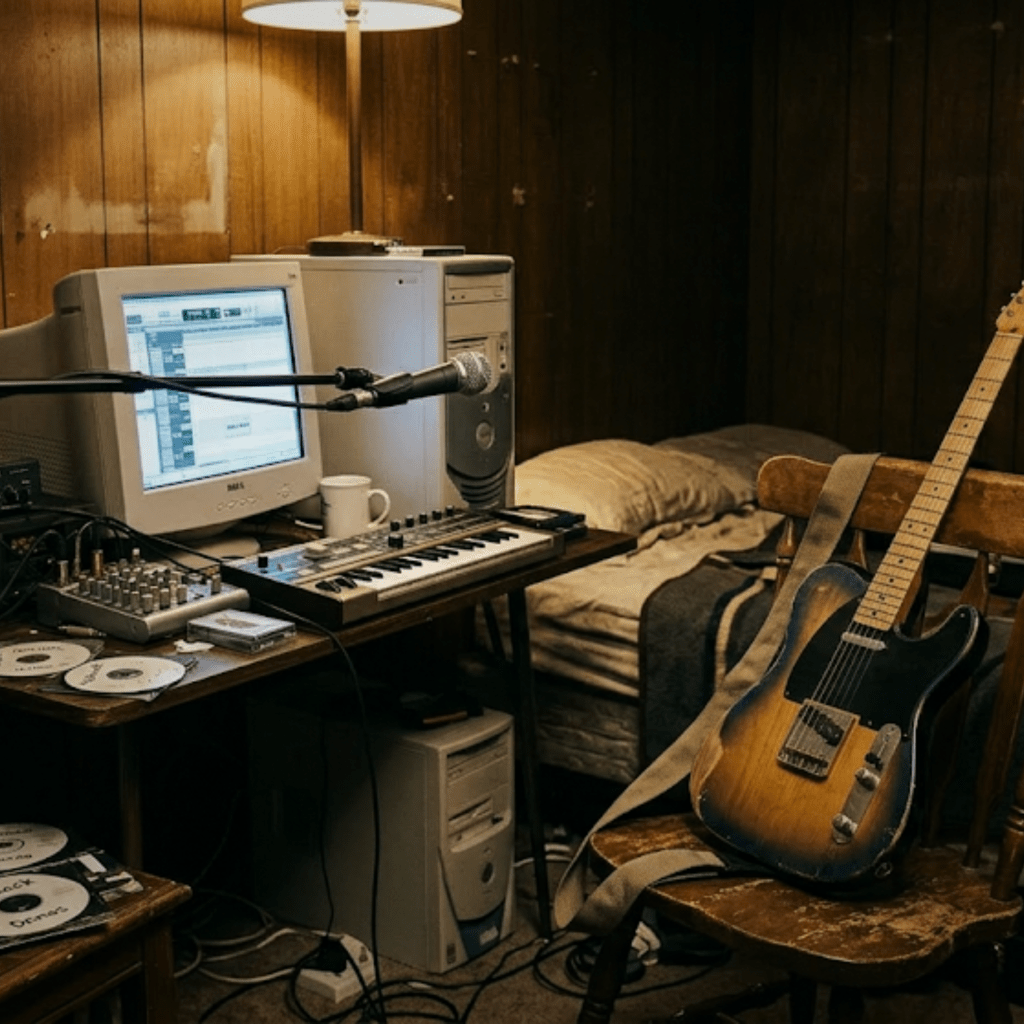
The 2000s didn’t produce a single defining aesthetic. Instead, there were shared conditions: cheap gear, unstable work, internet distribution, loneliness, and a lot of time spent making music in small rooms.
That’s why artists from very different scenes strangely belong to the same moment.
Pinback was recording meticulous, melancholic songs that felt like they were built inside bedrooms. Their 2001 album Blue Screen Life captures that feeling perfectly. Quiet, precise, and slightly detached, like music made while staring at a glowing monitor late at night. The band often recorded ideas directly into computers whenever inspiration appeared, slowly building songs piece by piece rather than booking expensive studio sessions.
Around the same time, The Black Keys was taking an even more literal basement approach. Their raw 2002 debut The Big Come Up was recorded in drummer Patrick Carney’s basement using a small multitrack recorder and just a few microphones. The blown-out sound wasn’t really a stylistic decision. It was simply what happened when two musicians recorded blues rock with whatever gear they could afford.
By the middle of the decade, isolation began producing entirely new kinds of music. Burial turned late-night solitude into atmosphere on his 2006 self-titled debut Burial. Built almost entirely on a home computer, the record’s crackling textures and distant vocal fragments sounded less like studio recordings and more like transmissions from empty city streets.
That same year, Jay Reatard released Blood Visions, a record that felt like it might fall apart at any moment. Short, violent songs driven by four-track chaos where immediacy mattered far more than fidelity.
A couple of years later, Crystal Castles captured a different side of the decade’s instability. Their 2008 debut Crystal Castles translated internet anxiety into blown-out electronics and damaged pop structures that felt both nostalgic and unstable.
Different sounds. Same survival instinct.
For many artists in the 2000s, the studio was often just a desk corner. A four-track recorder, a cheap interface, a laptop, maybe a small amp.
In a way, the decade sat right in the middle of a quiet technological shift. The home recording culture that began with cassette four-tracks in the ’90s was colliding with the rise of laptops and early digital audio workstations. Some artists were still working with the limitations of tape machines and simple multitrack setups. Others were beginning to build entire records inside computers.
The tools changed, but the logic stayed the same.
Not the best gear.
Just the gear that was available.
That limitation shaped the sound. Distortion, clipping, tape saturation, and digital artifacts became part of the language.
Because the tools were cheap, the music often sounded fragile, unstable, and honest.
Vintage gear wasn’t fetishized yet. It wasn’t an investment strategy. It was simply equipment people used because it worked and they could afford it.
That mentality shifted later in the 2010s, when platforms like Reverb turned old machines into commodities and nostalgia became part of the economy of music.
But during the 2000s, most of it was simply survival.
Genres fragmented. Scenes got smaller. The internet accelerated everything.
Music traveled faster than money ever could. Songs went global. Artists stayed broke.
For many listeners, that era now lives in specific memories. MP3 folders full of corrupted downloads, late-night headphone listening, blogs sharing links that might disappear the next morning.
For me, the 2000s feel like background noise from childhood.
Albums playing quietly in empty rooms.
Songs discovered accidentally.
Dreams that never quite turned into careers.
Nobody was trying to become legendary.
Everyone was just trying to keep going.
That’s why these artists belong together.
The 2000s weren’t about manifestos.
They were about quiet resistance.
Making music anyway.
With cheap tools.
Inside broken systems.
Years when we were all broke and kept playing anyway.
